

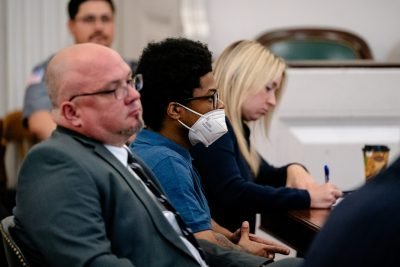
The future of Autreyu Massaline’s murder retrial now lies in the hands of a New York appellate court, which is weighing a petition seeking to block the second trial altogether.
Massaline was set to face a new jury Friday after a judge declared a mistrial in May on a charge of second-degree murder stemming from the July 2025 stabbing death of 54-year-old Edward Warren in Ithaca. But the Oct. 23 retrial is now off the Tompkins County Court calendar.
The defense argues that the mistrial was declared prematurely, making a retrial unconstitutional under double jeopardy protections, which generally prevent a person from being prosecuted twice for the same offense.
Tompkins County District Attorney Matthew Van Houten said in a statement that this type of proceeding is common under the circumstances.
“While I can’t comment on the specific legal arguments in the petition, I do not believe that the petition has merit and we will be opposing it,” Van Houten said.
He added that his office “fully expects” a retrial in early 2027 and is prepared to prosecute the case “fairly and zealously.”
During his original trial, Massaline admitted to stabbing Warren but testified that he acted to protect himself, his pregnant fiancée and their young daughter following a confrontation involving threats and racial harassment. Prosecutors argued the stabbing was an intentional killing.
Jurors acquitted Massaline of an evidence-tampering charge but reached an “impasse” on the murder charge. Despite objections from the defense, Judge Joseph Cassidy declared a mistrial after determining that the jury was “unlikely” to reach a verdict on the top charge.
In the latest development, Massaline’s attorneys — the Mayersak & Weiss Law Office — filed an Article 78 petition on Sept. 14 with the New York Supreme Court’s Appellate Division, Third Department, seeking to prevent another trial on the murder charge.
The legal proceeding allows certain actions by government officials, including judges, to be challenged in court. Massaline’s attorneys are seeking a writ of prohibition, which would bar another trial if the court determines it would violate Massaline’s constitutional rights.
The case and first trial
Opening arguments in Massaline’s first trial began May 13 and centered on conversations about race and self-defense, as well as what happened that fateful day of July 24, 2025 on Elmira Road.
According to testimony, Warren mistakenly believed Massaline’s fiancée, Kaciana Camel, had stolen his bicycle. Camel, who is Black, testified that Warren repeatedly shouted racist and misogynistic slurs at her as she walked with the couple’s two-year-old daughter. Warren also allegedly threatened to “deflate” Camel when she told him she was pregnant.
Camel and another witness called 911 during the confrontation. Massaline, who had been listening to the altercation over the phone, left the couple’s apartment with a knife and encountered Warren near the intersection of South Plain Street and Elmira Road.
Seconds later, Massaline stabbed Warren in the torso. Warren later died from his injuries.
After roughly two and a half days of deliberations and evidence review, the jury could not reach a decision on the top charge and asked the court for guidance.
The prosecution requested a mistrial, while the defense pushed for an Allen charge, an instruction encouraging a deadlocked jury to keep deliberating. Cassidy ultimately sided with prosecutors, saying the jury had worked diligently and was unlikely to reach a conclusion.
“This is a very serious case, I understand that. But factually, it’s not extremely complex,” Cassidy said at the time, according to the petition.
“They’re not making this request lightly,” Cassidy added.
The appellate challenge
In August, Massaline rejected a plea deal that would have required him to plead guilty to first-degree manslaughter in exchange for a prison sentence of 12 to 18 years, followed by five years of post-release supervision. If another trial proceeds and Massaline is convicted of second-degree murder, prosecutors have said they would seek a sentence of 25 years to life in prison.
The defense now argues that the mistrial was declared prematurely because there was no indication that the jury was “hopelessly deadlocked.”
Massaline’s defense argues for the writ of prohibition, saying an ordinary appeal does not properly protect his right against double jeopardy. If a mistrial is declared too quickly without a solid reason or the defendant’s consent, the government may not be allowed to retry the case.
The petition also notes several times that Massaline, who is Black, was tried by an “all-white jury.” Both the prosecution and defense attorneys participate in selecting a jury, with each side permitted to challenge prospective jurors during the selection process.
According to court filings, the county court granted a stay, temporarily halting the retrial pending a decision on the petition.
In an Oct. 16 letter to the appellate court, the District Attorney’s Office said prosecutors received an extension until Oct. 23 to file their response after misunderstanding the original deadline.
Massaline’s attorneys requested expedited consideration of the petition, citing his continued incarceration and desire to resolve the matter as soon as possible. The Mayersak & Weiss Law Firm did not respond to an additional request for comment.
In a Sept. 28 letter to the appellate court, the New York Attorney General’s Office said Cassidy had elected not to appear in the proceeding and took no position on the motion, and neither admitted nor denied the claims made in it.
Editor’s Note: Due to an internal error, the initial version of this article that was published did not include all of the edits. One factual error that was included in the previous version was one instance of Autreyu Massaline’s name being misspelled.
The post Petition puts Massaline murder retrial on hold appeared first on The Ithaca Voice.

